





CHAPTER
02
Development for Common Prosperity
SUSTAINABLE DEVELOPMENT CONTEXT IN 2024
In 2024 - the halfway point in implementing the United Nations 2030 Agenda – the global pursuit of sustainable development goals continues to face complex and interconnected challenges across economic, political, environmental and social dimensions:
View moreAccording to the Vietnam Institute for Economic and Policy Research (VEPR), under the University of Economics - Vietnam National University, Vietnam continues to target GDP growth of 7-8% in 2024, with policies which prioritizes energy transition and green development. Key highlights from Vietnam’s economy performance in the past year includes:
View moreThe global fertilizer and chemical areas are undergoing a profound transformation, driven by mounting pressure to reduce emissions, comply with new climate regulations, and respond to a wave of technological innovations focused on environmental sustainability.
View moreIn response to growing global and national demands for sustainable development, PVFCCo has clearly demonstrated its commitment and proactive approach to environmental, social and governance (ESG) issues. As a key enterprise in Vietnam’s fertilizer production sector - an industry closely tied to food security and the livelihoods of millions - PVFCCo has implemented specific actions to maintain its domestic leadership and expand into regional markets:
View more
PVFCCO’S SUSTAINABILITY ORIENTATION
Sustainable development plays a key role in PVFCCo’s long-term growth strategy, especially in the context of climate change, resource depletion, and rising pressure from environmental regulations at both national and global levels. As a pioneer in fertilizer and chemical production in Vietnam, PVFCCo clearly understand its responsibility to balance the goal of maximizing business efficiency with the goal of reducing negative impacts on the environment and social. This helps support the nation’s and the industry’s sustainable development goals.
STAKEHOLDER ENGAGEMENT
To identify sustainable development topics and carry out ESG solutions, initiatives, and programs that match market trends and stakeholders’ needs, PVFCCo always focuses on building a strong connection with stakeholders.
PVFCCo achieved many remarkable results in 2024 through its stakeholder engagement and consultation activities as follows:


Workers

Customers (distributors, end users, etc.)

Shareholders / Investors

Business partners

Government authorities

Local community
Through the stakeholder engagement activities executed in 2024, PVFCCo has also identified a list of ESG topics which each stakeholder pays attention to, detailed as follows:

Workers
Customers (distributors, end users, etc.)
Shareholders / Investors
Business partners
Government authorities
Local community
MATERIAL TOPICS
According to globally recognized ESG reporting standards and guidelines, businesses are expected to identify and assess material sustainability topics, monitor and update them regularly, and allocate limited resources to activities and programs that can generate positive impacts on the economy, environment and society. This process provides a solid foundation for PVFCCo to implement its sustainable development strategy more effectively, while also meeting stakeholder expectations and addressing their concerns.
The analysis and assessment of each ESG topic’s materiality is based on PVFCCo’s stakeholder engagement process, combined with internal evaluation. These activities are conducted in accordance with GRI Standard 3 under the GRI Universal Standards 2021. Annually, PVFCCo’s responsible department reviews, adjusts, and supplements this analysis to reflect national sustainable development trends, the Corporation’s core business areas, and stakeholders’ expectations.
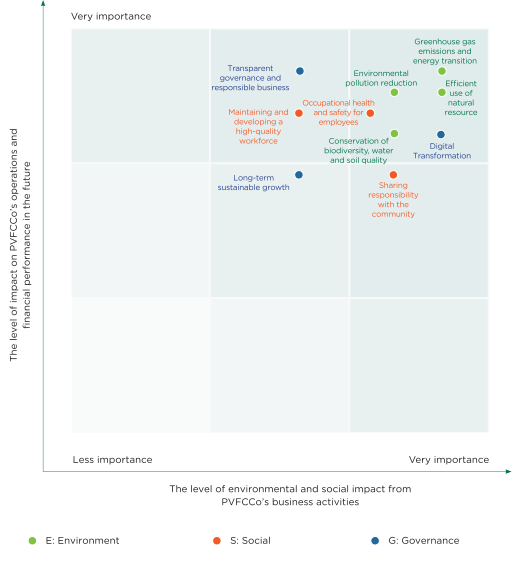
This entire analysis and evaluation process is summarized into four main steps as follows:
Detailed information on the ESG material topics presented in the 2024 Sustainability Report is presented in the following table:
| Topic | Content | Contribute to the United Nations Sustainable Development Goals (17 SDGs) |
|---|---|---|
| Greenhouse gas emissions and energy transition | PVFCCo plans and implements solutions to reduce greenhouse gas emissions. The Corporation also actively shifts to cleaner energy sources, with a focus on renewables, for use in core operations. |


|
| Efficient use of natural resources | PVFCCo enhances research and applies initiatives to improve the efficiency of using limited natural resources. It increases the use of recycled materials in fertilizer and chemical production and promotes circular economy practices through recycling and reusing waste and scrap. |


|
| Environmental pollution reduction | PVFCCo commits to strictly managing environmental impacts arising from its core business operations. The Corporation also researches and integrates appropriate environmental assessment criteria into the supplier evaluation and selection process, contributing to a more sustainable supply chain. |


|
| Conservation of biodiversity, water resources and soil quality | PVFCCo promotes the improvement of fertilizer products to be more environmentally friendly. These efforts aim to reduce negative impacts on water resources, enhance soil quality during agricultural use, and closely monitor ecosystem impacts to help preserve biodiversity in areas potentially affected by business activities and the consumption of PVFCCo’s fertilizer and chemical products. |


|
Greenhouse gas emissions and energy transition
Content
PVFCCo plans and implements solutions to reduce greenhouse gas emissions. The Corporation also actively shifts to cleaner energy sources, with a focus on renewables, for use in core operations.
Contribute to the United Nations Sustainable Development Goals (17 SDGs)
Efficient use of natural resources
Content
PVFCCo enhances research and applies initiatives to improve the efficiency of using limited natural resources. It increases the use of recycled materials in fertilizer and chemical production and promotes circular economy practices through recycling and reusing waste and scrap.
Contribute to the United Nations Sustainable Development Goals (17 SDGs)
Environmental pollution reduction
Content
PVFCCo commits to strictly managing environmental impacts arising from its core business operations. The Corporation also researches and integrates appropriate environmental assessment criteria into the supplier evaluation and selection process, contributing to a more sustainable supply chain.
Contribute to the United Nations Sustainable Development Goals (17 SDGs)
Conservation of biodiversity, water resources and soil quality
Content
PVFCCo promotes the improvement of fertilizer products to be more environmentally friendly. These efforts aim to reduce negative impacts on water resources, enhance soil quality during agricultural use, and closely monitor ecosystem impacts to help preserve biodiversity in areas potentially affected by business activities and the consumption of PVFCCo’s fertilizer and chemical products.
Contribute to the United Nations Sustainable Development Goals (17 SDGs)
| Topic | Content | Contribute to the United Nations Sustainable Development Goals (17 SDGs) |
|---|---|---|
| Occupational health and safety | PVFCCo commits to complying with current legal regulations, international standards and recognized the best practices on occupational health and safety. The Corporation continues to operate systems that protect employees’ health and prevent work-related illnesses. |
|
| Maintaining and developing human resources to ensure quality | PVFCCo commits to maintaining a stable workforce through talent attraction and competitive remuneration policies compared to market levels. The Corporation focuses on developing employees’ professional expertise and essential skills to help them adapt quickly to the new technology era. It also promotes a dynamic, efficient, fair, and inclusive working environment, with equal promotion opportunities for women. |


|
| Sharing responsibility with the community | PVFCCo prioritizes social security efforts and consistently accompany PVN in social responsibility programs and activities. The Corporation shares and spreads positive values to the community, contributes to a prosperous nation where no one is left behind. |

|
Occupational health and safety
Content
PVFCCo commits to complying with current legal regulations, international standards and recognized the best practices on occupational health and safety. The Corporation continues to operate systems that protect employees’ health and prevent work-related illnesses.
Contribute to the United Nations Sustainable Development Goals (17 SDGs)
Maintaining and developing human resources to ensure quality
Content
PVFCCo commits to maintaining a stable workforce through talent attraction and competitive remuneration policies compared to market levels. The Corporation focuses on developing employees’ professional expertise and essential skills to help them adapt quickly to the new technology era. It also promotes a dynamic, efficient, fair, and inclusive working environment, with equal promotion opportunities for women.
Contribute to the United Nations Sustainable Development Goals (17 SDGs)
Sharing responsibility with the community
Content
PVFCCo prioritizes social security efforts and consistently accompany PVN in social responsibility programs and activities. The Corporation shares and spreads positive values to the community, contributes to a prosperous nation where no one is left behind.
Contribute to the United Nations Sustainable Development Goals (17 SDGs)
| Topic | Content | Contribute to the United Nations Sustainable Development Goals (17 SDGs) |
|---|---|---|
| Long-term sustainable growth | PVFCCo evaluates and selects investment projects that ensures economic efficiency, supports stable production and business operations, and generates long-term sustainable profits. Together with PVN, the Corporation contributes to building a strong foundation for national economic growth. |

|
| Transparent governance and responsible business | PVFCCo commits to complying with current legal regulations, international standards, and recognized best practices in corporate governance. The Corporation ensures responsible business conduct and provides timely, complete, and transparent information to strengthen trust among investors, shareholders, customers, and the community, while enhancing its position in the global market. |

|
| Digital Transformation | PVFCCo strongly promotes digital transformation across all aspects of its production and business operations. The Corporation applies modern information technology solutions to measure and monitor productivity, business performance, and environmental and social impacts. It increases the level of automation in operational processes and data management, while ensuring system synchronization, data security, and cybersecurity. |
|
Long-term sustainable growth
Content
PVFCCo evaluates and selects investment projects that ensures economic efficiency, supports stable production and business operations, and generates long-term sustainable profits. Together with PVN, the Corporation contributes to building a strong foundation for national economic growth.
Contribute to the United Nations Sustainable Development Goals (17 SDGs)
Transparent governance and responsible business
Content
PVFCCo commits to complying with current legal regulations, international standards, and recognized best practices in corporate governance. The Corporation ensures responsible business conduct and provides timely, complete, and transparent information to strengthen trust among investors, shareholders, customers, and the community, while enhancing its position in the global market.
Contribute to the United Nations Sustainable Development Goals (17 SDGs)
Digital Transformation
Content
PVFCCo strongly promotes digital transformation across all aspects of its production and business operations. The Corporation applies modern information technology solutions to measure and monitor productivity, business performance, and environmental and social impacts. It increases the level of automation in operational processes and data management, while ensuring system synchronization, data security, and cybersecurity.
Contribute to the United Nations Sustainable Development Goals (17 SDGs)
SUSTAINABILITY MANAGEMENT AT PVFCCO
SUSTAINABILITY GOVERNANCE STRUCTURE
PVFCCo designs its sustainable development management system to be streamlined and effective. The system ensures clear roles and responsibilities from planning to implementation, monitoring, and improvement. Management activities are carried out regularly, continuously, and are closely integrated across the following steps:
In addition to clearly defining the functions and activities as above, PVFCCo also continuously strengthens and perfects the ESG governance structure with specific assignment of tasks to each designated personnel. In 2024, PVFCCo maintained the governance structure as shown below:

| Function | Unit / Object | Main responsibilities related to Sustainable Development |
|---|---|---|
| Planning / Monitoring / Improvement | Chairman of the Investment, Development and Science and Technology Committee under the Board of Directors (Independent Board Member) |
|
| Execution / Monitoring / Improvement | General Director |
|
| Deputy General Director in charge of internal affairs, occupational health and safety, legal compliance |
|
|
| Execution / Monitoring / Improvement | Technical and Safety Department |
|
| Execution / Monitoring / Improvement | Department/ Division/ Functional Unit |
|
ESG RISK MANAGEMENT
In the context of a volatile economy and growing pressure from geopolitical, environmental, and social issues, PVFCCo clearly recognizes the importance of managing risks related to sustainable development across all production and business activities. The Board of Directors understands that ESG-related risks can directly or indirectly affect operational efficiency, competitiveness, brand reputation, and the Corporation’s ability to create long-term sustainable value.
To respond proactively to challenges and seize growth opportunities in the transition toward a greener and cleaner economy, PVFCCo continuously improves its policy framework and risk management processes. Thanks to its consistent efforts, PVFCCo has not recorded any serious environmental or social incidents throughout more than 20 years of establishment and development.
In 2024, PVFCCo continues to identify, assess, and control ESG-related risks within the framework of its enterprise-wide risk management system, in compliance with prevailing international standards. Specifically:
- ESG risks are identified and periodically assessed in accordance with ISO 9001 (quality), ISO 14001 (environment), and ISO 45001 (occupational health and safety), as well as the Quality - Safety - Environment Risk Control Process (A-002).
- Risk identification and assessment results are regularly monitored and updated whenever unusual factors or events occur. This helps detect and control potential risks that may affect operational continuity and efficiency, and ultimately the Corporation’s financial performance. For example, in 2024, the reallocation of functions and management areas between the NPK Unit and the Packaging and Warehousing Unit at Phu My Fertilizer Plant was carefully assessed for risks such as overlapping roles, changes in employee work habits, and impacts on operational performance. Similarly, adjustments to raw materials, chemicals, and environmental treatment methods are all subject to risk assessment before implementation.
After identifying and assessing ESG risks, specialized departments and functional units review and implement control plans and response measures in line with PVFCCo’s overall risk management policy. Building on this process, these efforts aim to minimize negative impacts and ensure stability and effectiveness in executing the sustainable development action plan. To ensure ongoing oversight, key risk indicators (KRIs) are regularly monitored, and ESG risk management is reported periodically, with discussions held in meetings with the Board of Directors.
To enhance risk management capabilities, PVFCCo has deployed advanced tools such as the Process Safety Management (PSM) software and the Production Management Information System (PMIS). These systems support the monitoring of incident numbers and production downtime caused by safety violations at Phu My Fertilizer Plant. In addition, PVFCCo regularly organizes internal training programs on risk assessment and control for all employees and encourages departments and units to proactively improve operational risk management processes and contribute to the development and refinement of risk criteria and parameters.
PVFCCo has identified and managed a portfolio of risks related to sustainable development with corresponding monitoring and control measures as follows:
| No | Group | Risk | Key monitoring and control measures |
|---|---|---|---|
| 1 | Strategic risk | Risks from consumer behavior |
|
| 2 | Strategic risk | Transition risks related to production technology, legal regulations, government policies, consumer preferences for greener and cleaner products, etc. |
|
| 3 | Strategic risk | Risks related to the supply chain such as domestic raw material shortages and/or disruptions due to geopolitical tensions in some important regions of the world, rising gas prices, etc. |
|
| 4 | Operational risk | Risks related to product quality |
|
| 5 | Operational risk | Fire Risk |
|
| 6 | Operational risk | Climate change related risks |
|
| 7 | Operational risk | Occupational safety risks and diseases |
|
| 8 | Operational risk | Risk of brain drain (well-qualified and experienced technical staff/ experts) |
|
| 9 | Operational risk | Risk of fraud and corruption |
|
| 10 | Financial risk | Tax related risks |
|
| 11 | Compliance Risk | Compliance risks |
|
| 12 | Compliance Risk | Environmental liability risks (e.g. incidents of wastewater / exhaust gas treatment systems, etc.) |
|